

How the score works
One question, one number, and a set of rules about when that number is worth reading. This page explains all three, so you know what your score can tell you and what it cannot.
The question
Every family is asked: “How likely are you to recommend [your studio] to another family?”, on a scale from 0 (not at all likely) to 10 (extremely likely). The eleven numbers sit inside the email, so a parent answers with one tap. Two written questions follow, and both are optional.
Three groups
Each answer falls into one of three groups. SARA shows the group in its own color everywhere, and always beside the word or the number.
| Answer | Group | What it usually means |
|---|---|---|
| 9 or 10 | promoter | Happy, and likely to say so to other families. |
| 7 or 8 | passive | Satisfied, but not enthusiastic. Neither adds to the score nor takes from it. |
| 0 to 6 | detractor | Unhappy about something. These families appear on your worklist. |
The calculation
The score is the share of answers that are promoters, minus the share that are detractors, as a whole number. It runs from −100 (everyone a detractor) to 100 (everyone a promoter). Passives count toward the total but neither add nor subtract.
For example, 60 families answer: 30 promoters, 20 passives and 10 detractors. Promoters are 50% of answers and detractors 17%, so the score is 33.
A family who writes a comment but never picks a number is counted as “no score given”. Their words are kept and read; they are just not part of the number.
No score under 30 answers
With only a handful of answers, the score moves more with who happened to reply than with anything happening at your studio. With ten answers, the range around the score is close to fifty points either side. So until 30 families have given a number, SARA shows the counts and holds the score back, with a line telling you how many answers it is waiting for:
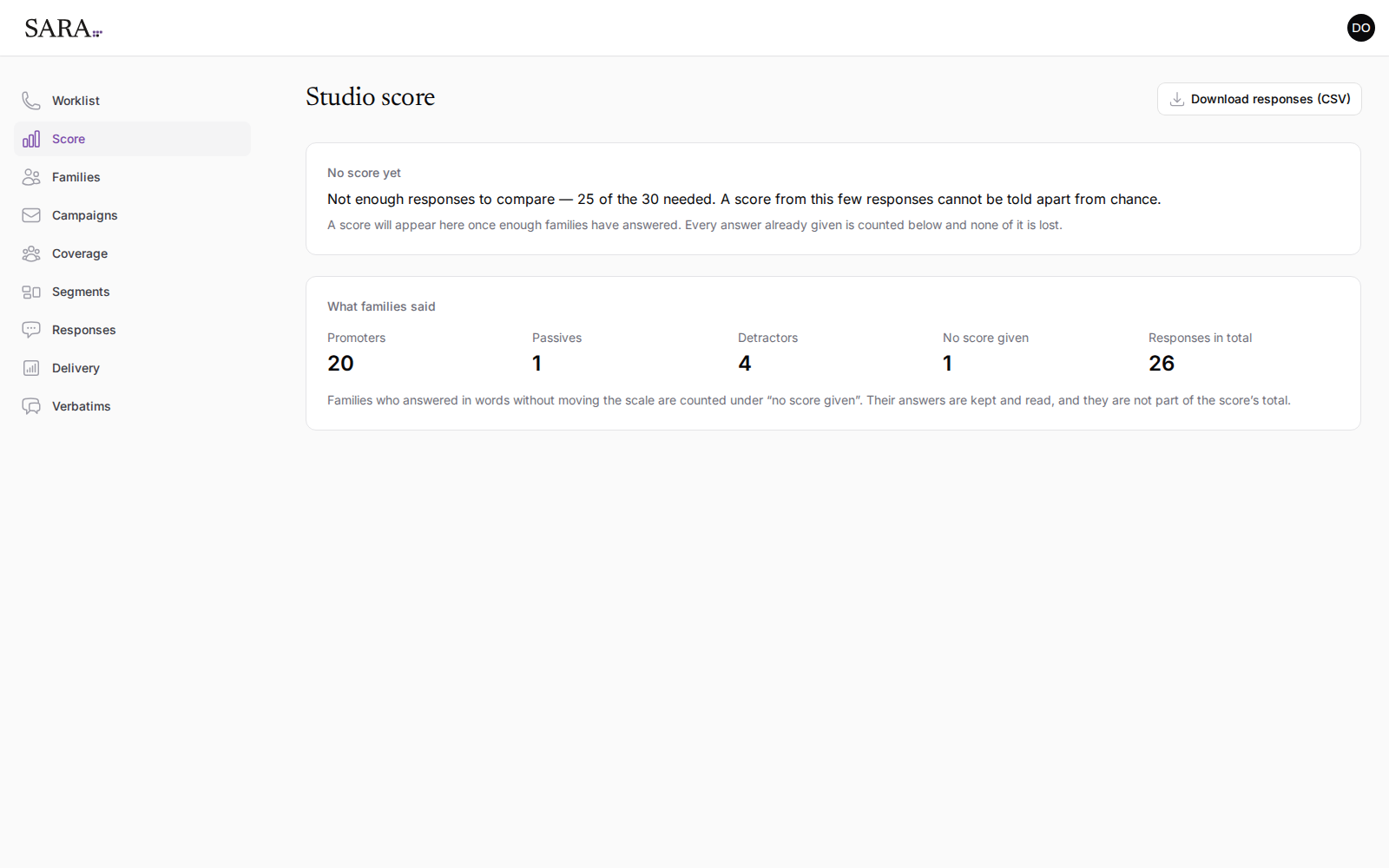
The same rule applies to every group of families SARA compares on the Segments page, separately. Your whole-studio score appears well before any single segment’s does.
Reading the range
Every score comes with a plausible range: the span where the true figure for your studio probably sits, given how many families answered. In the example above, 60 answers giving a score of 33, the range is 14 to 52.
- A change smaller than the range is not news. Going from 33 to 38 between two rounds of 60 answers could be chance alone.
- More answers narrow it. The same mix of answers from 400 families gives a range less than half as wide.
- The score always shows how many answers it rests on, so you can judge this for yourself.
What the score is not
- It is not a prediction. SARA does not guess which families will leave; it shows you who said they were unhappy, and why.
- It is not comparable with other studios. SARA shows no industry averages: a number about other studios, shown under your name, would be misleading.
- It is not the point. The families on your worklist, and what they wrote, are the part to act on.
← For front-desk staffHow families’ information is handled →